


If you find value in my newsletter and want to support the work that goes into it consider —> [☕Buy Me a Coffee☕]💡 Want more from me? [SEO Strategy Course] | [Build Your Own SEO Tools (with Python & Agentic AI)] | [Premium SEO Mastermind]
Alternatively you can become a paid subscriber:
Intro
I read a post recently how just few years ago Wikipedia was considered pseudoscience, yet today, somehow, we’re perfectly comfortable consuming content from AI Overviews and AI Mode systems that, by their very nature, can hallucinate. Ironic, isn’t it?
That’s why I believe the right mindset to thinking can take you places nothing else can. How often do we push back on or question the sheer volume of information thrown at us every time we scroll on social media for example?
That’s also why last week I wrote about spotting good SEO research from, well the not so good :)
This week I want to talk about a concept very often confused, and how a symptom is not the same as the disease.
Wait a minute… is this an SEO newsletter or a medical journal?
Don’t worry, it’s just an analogy. But it’s one worth exploring, so buckle up!
The symptom vs. the root cause
You get a headache, you focus on “treating the headache”… but the headache is just a symptom of an underlying problem. If you identify the actual problem and fix it, the headache and any other related symptoms will be gone!
The thing is, a headache can be a symptom to various conditions varying in severity:
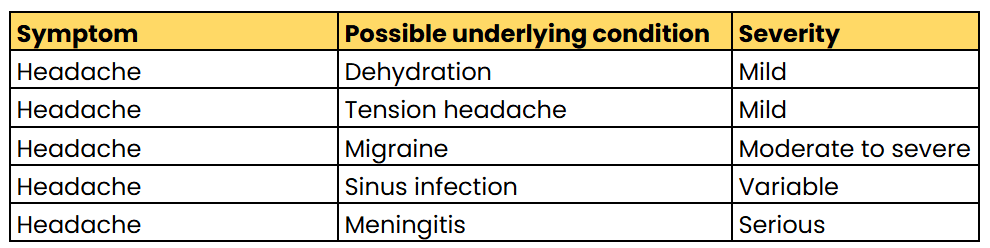
and it needs medical understanding, and good diagnosis to narrow down the root cause. You cannot jump to conclusions, or just attempt to treat every possible root cause. That would be madness 😄
The SEO root cause
Any SEO who saw a traffic decline in the past year+ will understand this: stakeholders will always say it’s because of AI Overviews and AI Mode in search (only). Before there was AI in search, people would attribute any traffic decline to “google updates”.
I can list a lot of such “diagnosis” that I saw people use throughout the years of my work. The problem is this mindset, is not helpful in actually fixing the issue.
Another time, we become fixated on the symptom itself. Your new website not getting indexed? we throw everything we know at it, every tactic we can think of. But understanding the root cause would help you narrow down and prioritize what may actually work, and if you’re working with a team you’re saving their time.
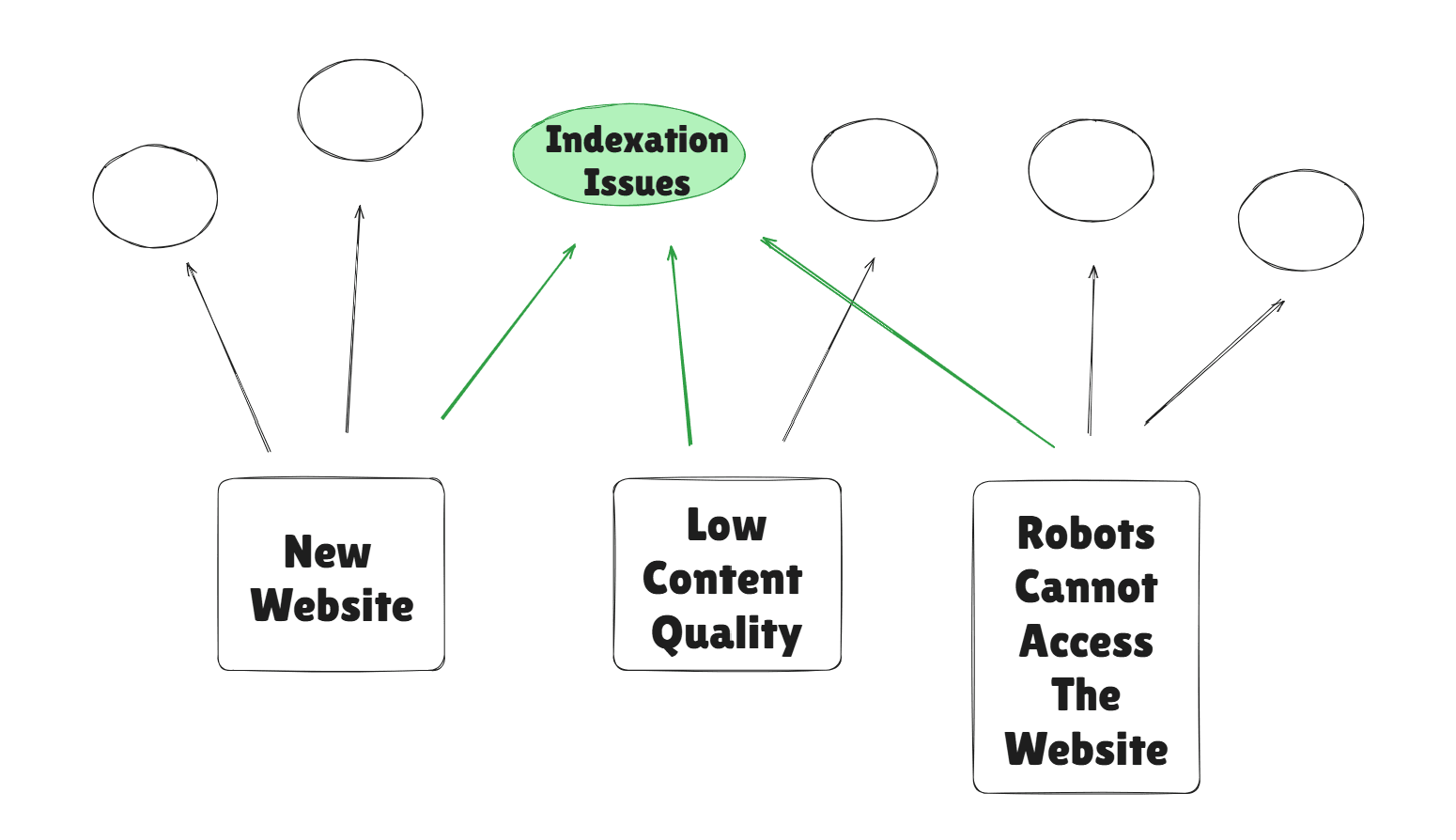
So we need to focus on finding the root cause, and understand that an SEO issue, can be just a symptom of something else.
The 5 whys
One of the simplest frameworks of getting down to the root cause of something is asking why 5 times. And the best thing, finding and addressing a root cause, can resolve the issue at hand, plus other issues you didn’t even realize you have!
Example: Google is not indexing website URLs
Initial symptom: A website has 500 URLs that are not being indexed by Google.
The 5 why step by step:

As you can see in the scenario above, the problem wasn’t really an indexation issue. That was the symptom. The actual underlying cause was the faceted navigation.
And by fixing this one thing, I’m pretty sure a lot of other positive outcomes could follow.
Beyond improved indexation, for example, you could also see improvements in rankings, as you’d have better control over canonical URLs and a more intentional approach to URL generation. You could also improve the user experience by ensuring that only a carefully selected set of useful URLs is created, rather than generating countless variations that offer little additional value.
In other words, find the root cause, and fix it, and potentially multiple positive outcomes can come.
Here’s another way this could’ve gone:

Again, in this scenario, the indexation issue is not the actual problem it’s a symptom. The actual root cause was the website information architecture. While this is a big fix, it will address a lot of other fundamental SEO issues and improve overall website performance.
That’s the magic of finding the root cause, and that’s also how to build your strategy. Find the root causes and prioritize them instead of going after small tactics and a fix here and there.
Flashback: how to find the root cause
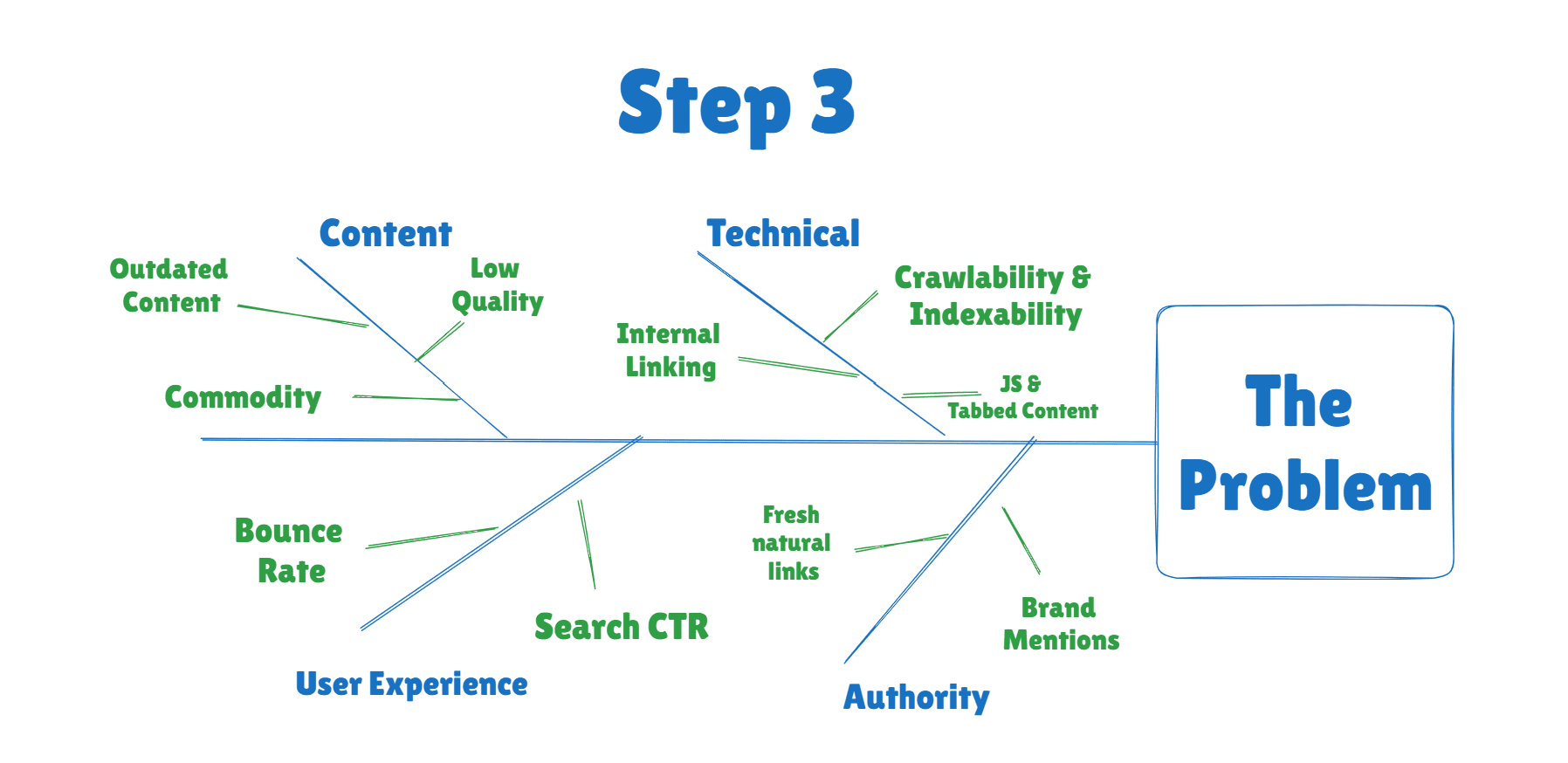
I wrote before about The Cause and Effect: How to Diagnose SEO Problems and presented how the fishbone analysis model can help narrow down the potential causes. You may want to check it out.
And That’s a Wrap (Almost 😄)
It’s always a good idea to sit back and reflect on the way we think or our thinking patterns.
Usually, we’re focused on the output of our thinking (the conclusions we reach) and rarely on how we actually arrive at those conclusions.
But the process matters just as much, if not more.
Learning different frameworks like this helps develop the thinking muscles we need to deal with the new state of search.. AI search that is…
We have more information than ever before, all just one click away and at our fingertips. Access to information is no longer the problem. It’s how we process, question, interpret, and think about that information that really matters.
That’s that for today folks and see you in the next newsletter!
Support the Riddler!
Sign up for my newsletter if you’re not already. (Pssst, you can also become a paid subscriber)
Share the newsletter and invite your friends to signup. Help me reach 2k signups on Substack by end of 2026 please 🙂
Provide feedback on how I can make this newsletter better!!!
If you’re an SEO tool or an SEO service provider, consider sponsoring my newsletter. I’m also open to other partnership ideas as well.
Disclaimer: LLMs were used to assist in wording and phrasing this blog.