

If you find value in my newsletter and want to support the work that goes into it consider —> [☕Buy Me a Coffee☕]💡 Want more from me? [SEO Strategy Course] | [Build Your Own SEO Tools (with Python & Agentic AI)] | [Premium SEO Mastermind]
Alternatively you can become a paid subscriber:
Howdy!
We’ve all read an anti-programmatic SEO tip somewhere, and that creating content at scale using AI is definitely bad for SEO…
I agree… but I also don’t agree… and it seems that a lot of people share my same point of view.
I’ve written before about situations where programmatic SEO is not good. Basically this happens at the intersection of content created using AI, that is informational content, where no humans contributed. [read about this here]
But there is a time and place for everything and there are a lot of examples where programmatic SEO is a great tactic for your business.
When is programmatic SEO a good idea?
Early on in my SEO career I had the opportunity to work on a major programmatic SEO platform for a travel business (think Expedia level business). We wanted to create millions of pages for flights bookings, different destinations, hotel bookings, etc…
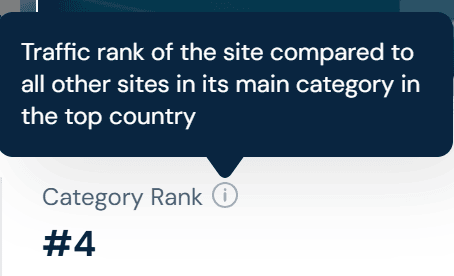
I worked first hand with developers and content writers to build this platform and was and still a success… the pages helped pull this website to 4th in it’s category (screenshot from free similar web traffic tool).
This was an excellent idea, and it was way before the era of chatgpt and AI content filling the web, but it was still a process of creating pages automatically at scale. Very easy to mess up, or create tons of duplicated pages, because we’re talking about millions of pages here, not 100 or 1000 pages for example.
How did we do it the right way?
Our content writers created tons of templated content for each page template. For example a destination/city hotel page template would a lot of different content templates all ready to fill in the gaps with information about that city and hotel. And each paragraph is completely swappable and adjustable across different hotel pages.
We also used external APIs to pull information about the weather of the city, quick facts, etc… and used those on the pages.
We also created our own stats of most expensive hotels, cheapest month to book a hotel, etc… We also added related charts.
We added FAQs about the city and travel booking to that city.
So the actual repetitive text on the page was minimal, the content is customized to the page intent and user needs, and there are actual human copywriters involved. The page provided real value to users.
And that worked! And this is not the only example you’ll find.
Where programmatic SEO works great today
I came across this tweet a while ago:
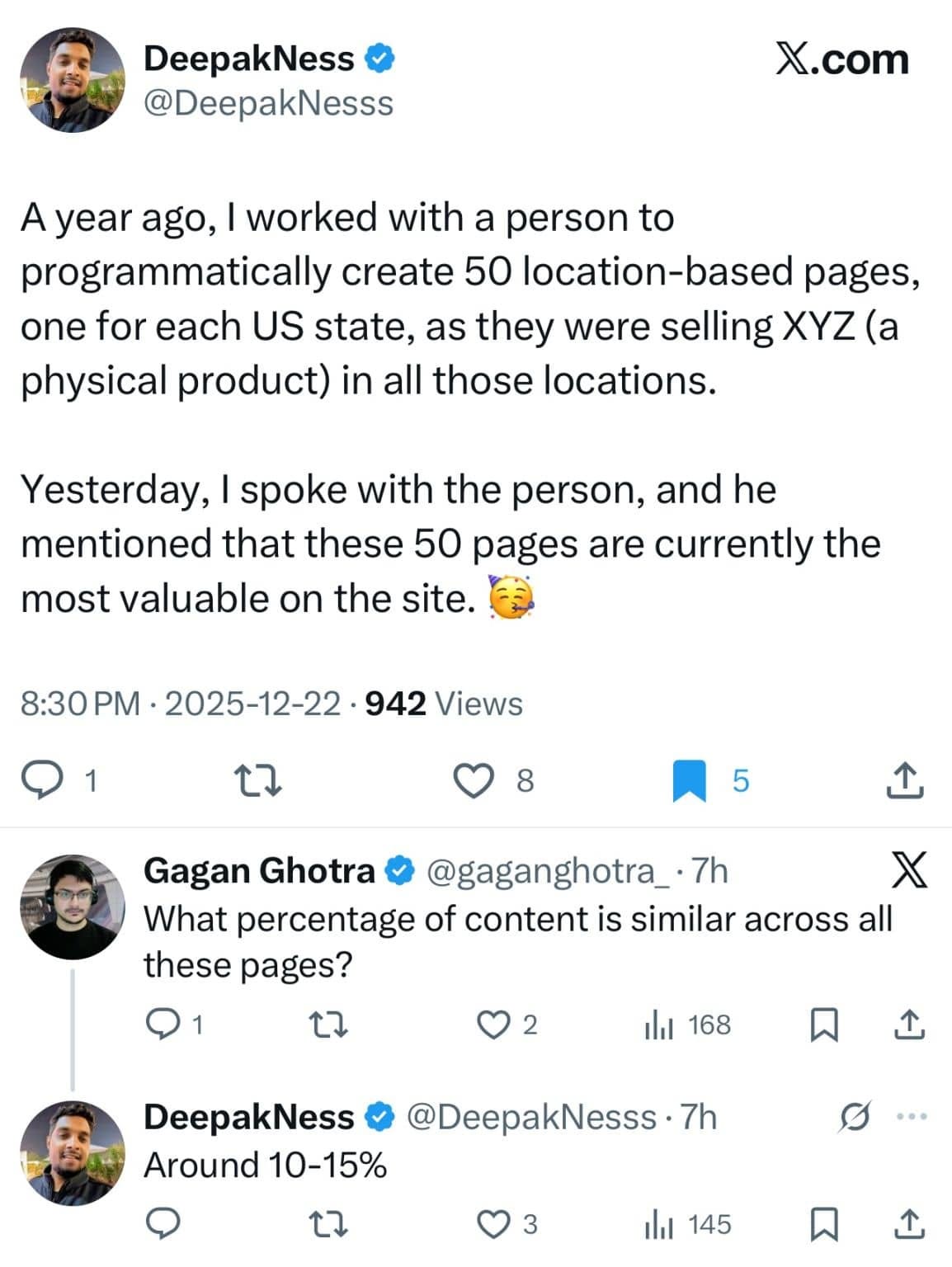
Obviously a small scale programmatic SEO example, but still shows programmatic SEO, if done the right way can work. In this example the posted stated that only 10-15% of the content across those 50 pages was similar. This is key. Each page needs to have unique-ish content, it needs to add value, it needs to serve a unique user intent, and humans needs to be involved.
Here’s a general tip: if you don’t put enough effort into those pages, chances are, you’re doing programmatic SEO the wrong way.
And again, this is not a one time off example, a lot of the major websites and organic players we see today have programmatic SEO as an integral part of their strategy (if not their entire strategy).
Airbnb: generates millions of search-optimized landing pages from templates and live listing data.
Amazon: dynamically generates millions of product, category, and attribute pages from structured catalog databases and templates to capture search demand at scale
and you know what there’s more… Zapier, Tripadvisor, Wise, Canva, and Zillow…
Each generates pages at scale using its own approach.
I also had the opportunity to work directly with someone on the team behind one of these well-known platforms, which gave me an even closer look at how they approached things.
What they all did right (and so should you):
Each one of those platforms made sure the pages generated are generally really useful to the user providing actual unique value they cannot easily get elsewhere on the web.
Amazon for example utilized User-Generated-Content and AI to collect reviews and generate unique insights on their products. [screenshot from a random product on amazon]
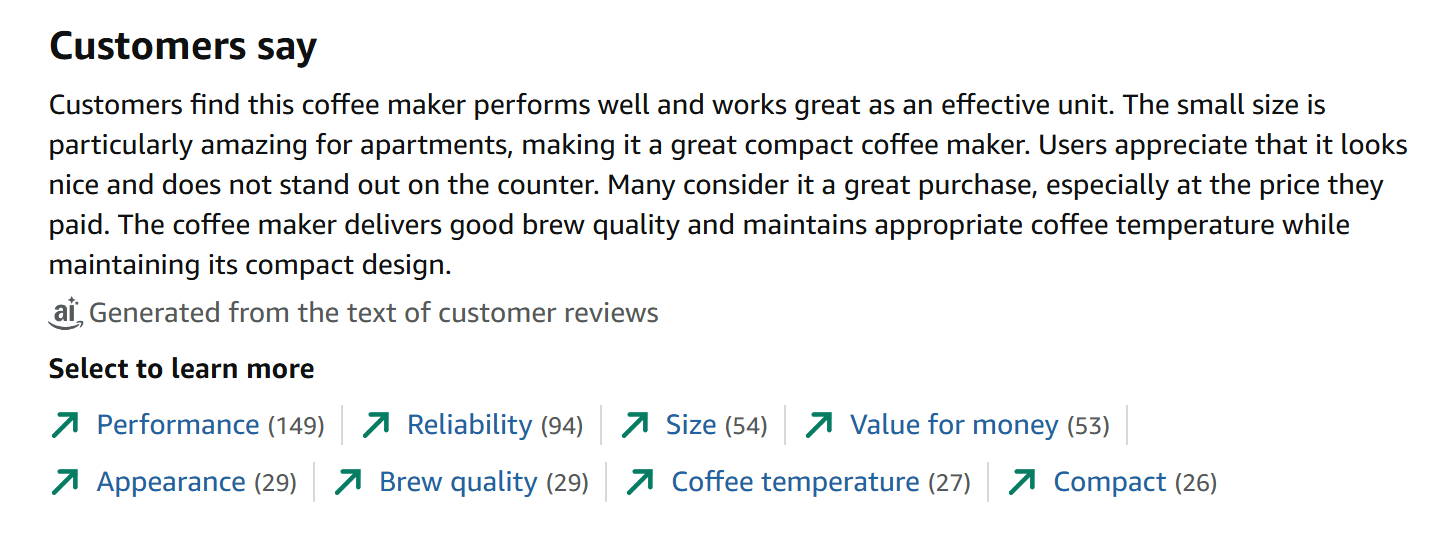
These websites offered users unique data per page ( each page surfaces genuinely distinct data like live rates, user reviews, etc…)
A lot of times the pages offer some type of a tool or utility, so users land on a functional tool, live listing, or ready-to-use template rather than a wall of generic text.
On Canva for example, each URL pulls unique, interactive designs from Canva’s library of templates, ensuring pages satisfy search intent rather than appearing as thin text.
The balance is important
Every SEO tactic that gets abused eventually gets flagged as spam. And then you start seeing tons of posts and case studies explaining why that particular tactic is bad for SEO….
People saw that listicles perform well in AI search, so they started pumping them out at scale. Google and LLMs then became more selective about the listicles they cite and use, and suddenly listicles are labelled as spam.
But are listicles really the problem? Do we mean we should stop using them just because some people abuse them? I cannot create a genuine listicle about whatever topic? We didn’t stop creating backlinks, did we? Nor did they stop working.
The same goes for programmatic SEO and pretty much any other SEO tactic. The problem is the abuse of a tactic to manipulate algorithms, not necessarily the tactic itself. Of course, some tactics are fundamentally manipulative, but that’s not what we’re talking about today.
What I’m trying to say is that you can do programmatic SEO without creating low-quality pages. You can create listicles without churning out hundreds of pointless articles. And you can build links without engaging in manipulative link schemes.
It’s all about understanding where the line is between using a tactic effectively and abusing it.
That balance is important, and it’s something I think we often lose sight of in SEO.
And That’s a Wrap (Almost 😄)
A lot of what we think is a good or bad tactic in SEO comes down to the mindset behind it. Fix the mindset and the right strategy will follow…
that has always been my approach… and today while it seems I’m talking about programmtic SEO, I’m actually also talking about the balance of assessing what tactics are good or not.
That’s that for today folks and see you in the next newsletter!
Support the Riddler!
Sign up for my newsletter if you’re not already. (Pssst, you can also become a paid subscriber)
Share the newsletter and invite your friends to signup. Help me reach 2k signups on Substack by end of 2026 please 🙂
Provide feedback on how I can make this newsletter better!!!
If you’re an SEO tool or an SEO service provider, consider sponsoring my newsletter. I’m also open to other partnership ideas as well.
Disclaimer: LLMs were used to assist in wording and phrasing this blog.