


Hello Riddlers!
📌 Your support keeps this newsletter FREE —> [☕Buy Me a Coffee☕]💡 Want more from me? [SEO Strategy Course] | [Build Your Own SEO Tools (with Python & Agentic AI)] | [Premium SEO Mastermind]
Truth Be Told
I’m about to once again step into the debate of GEO vs SEO 😄
Google has said on multiple occasions that they’re essentially the same thing. That there’s nothing particularly special or different you need to do for “GEO”.
But Google has also said a lot of things before…
…and ahem, we all know how some of those turned out 😄
So it was honestly refreshing to see Microsoft Bing publish a new blog discussing the difference between traditional search systems and grounding systems.
While much of the industry has been busy arguing whether GEO is “real” or not, Bing has quietly been one of the more transparent players during this AI-powered search wave.
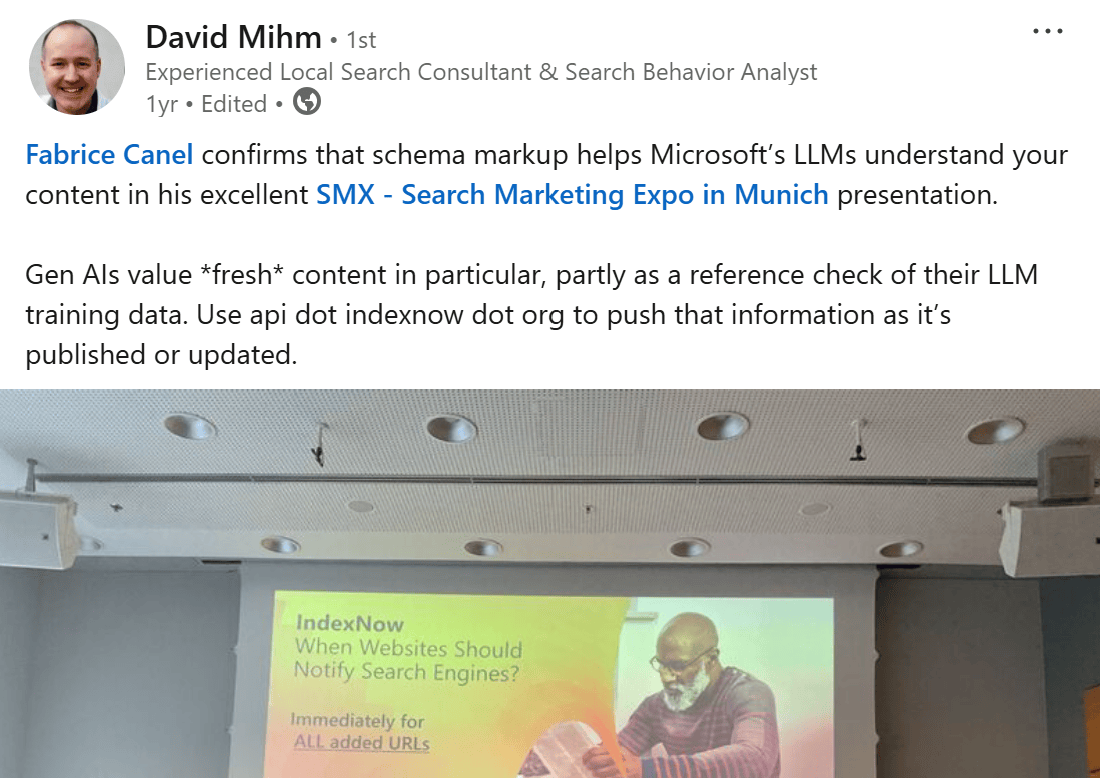
They introduced AI Answers reporting inside Bing Webmaster Tools, publicly discussed the role of schema and structured data for LLM understanding, and now they’re sharing more details about how indexing systems and grounding systems actually work behind the scenes.
So buckle up, because I’m about to dissect what all of this actually means for SEO 🙏
Two Systems, Two Questions
I really think it’s important to start from the top and acknowledge that traditional search, and LLMs grounding are two separate systems.
As the new Microsoft Bing blog explains:
“Traditional search and grounding systems share the same foundation – crawling, understanding, and ranking the web – but they are optimized for fundamentally different outcomes. “
Here’s a simple analogy to explain the difference.
You walk into a restaurant and the waiter hands you the menu. That’s traditional search: a curated list of options they think may satisfy what you’re looking for.
But then you ask the waiter, “What’s the best dish here?”
Now the waiter shifts from simply presenting options to giving you a direct recommendation based on context, interpretation, and experience.
And that’s essentially the difference between traditional search and grounding.
Traditional search presents you with possible sources and options.
Grounding attempts to synthesize those sources into a direct answer.
It also fits well with the classic “librarian” analogy we’ve used for years in SEO.
A librarian can point you toward the books or sections where the information exists.
But if the librarian directly answers your question based on their own reading and interpretation of those books… that’s a very different role.
One system retrieves information sources and serves you the most relevant.
The other synthesizes and delivers answers.
Traditional search asks: which pages should a user visit? (the menu)
Grounding asks: what information can an AI system responsibly use to construct a response? (the dish)
How They Work Differently
The two systems clearly have two different goals/outcomes. And therefore it’s reasonable to assume they work differently, but the good news we don’t have to assume anymore!
Traditional search is about serving the user a list of options, they believe are the best to answer the user query. When you look at SERPs, you don’t expect every single URL to be great for you but, you expect the results to be “right enough” so you find what you need.
If you’re searching for a black shirt, you’ll get a lot of options in SERPs, not every option necessarily fits your taste, but overall the results are relevant to your search and you can eventually find what you need.
AI answers has an additional constraint, the goal is not to point the user to information sources, it’s goal is to use those information sources to answer the user query (well that explains why the clicks are less, the system by design is about providing the answer directly to the user, citations or not).
AI answers use the index. Let’s make that clear, however, it’s not looking for entire pages, it’s looking for “groundable information – discrete, supportable facts with clear provenance”
This means the grounding system needs to decide:
Can I answer this question/user query
Do I have enough information to do so while preserving the meaning, making sure users can verify that if needed, and detecting and representing conflicting views when relevant?
This is where the two systems clearly are optimizing for different things.
Zooming In
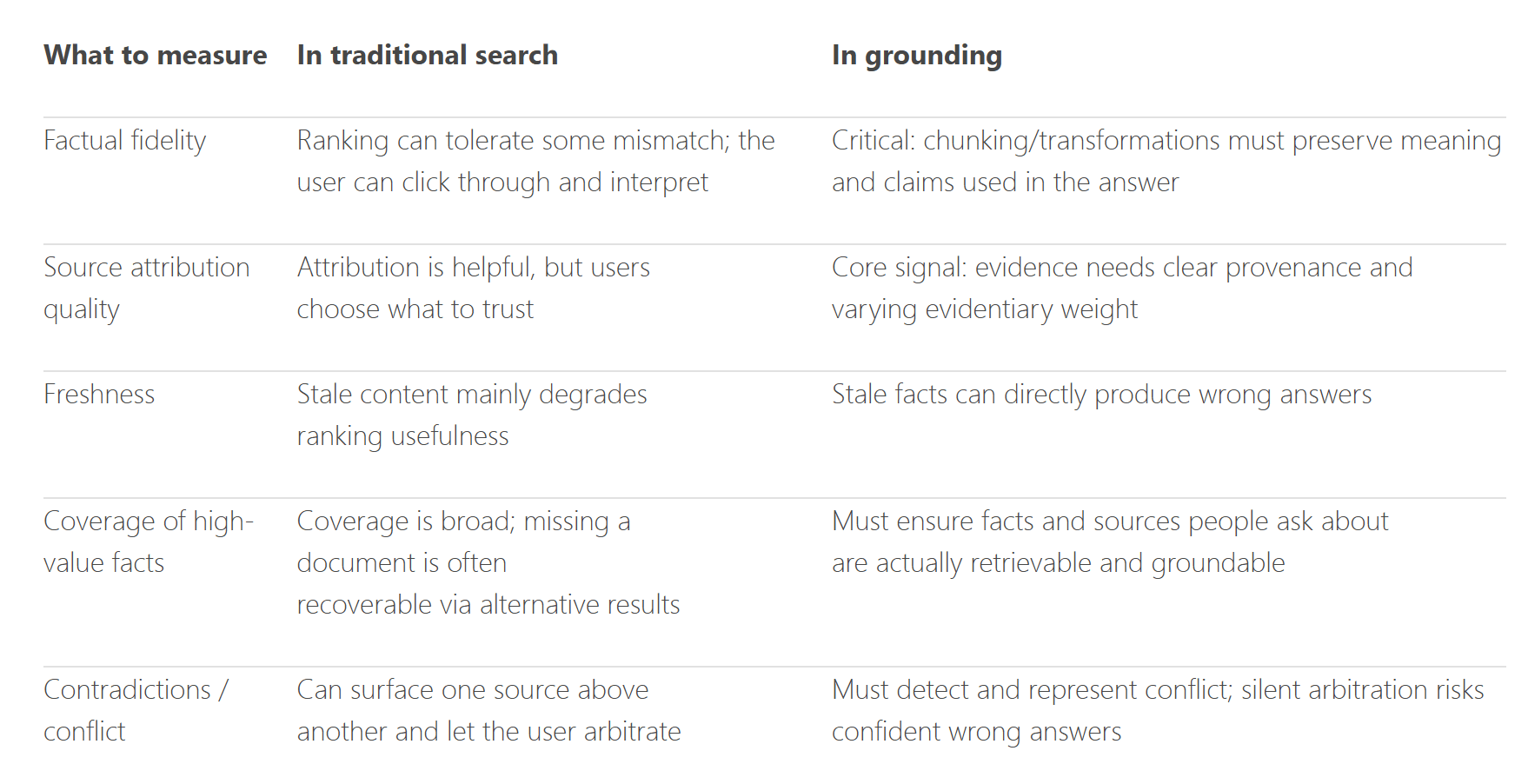
To be more clear, here are processes and things Grounding needs to account for, that traditional search does not:
AI systems often break content into smaller chunks (yes they chunk content) before retrieving it. The challenge is making sure the original meaning and context are still preserved after that process.
Source quality matters differently in AI answers. A grounding system cannot treat every indexed page as equally trustworthy if it’s going to generate a direct response from it.
Freshness becomes far more critical. In traditional search, outdated content may simply rank lower. In grounding systems, outdated information can directly become part of the answer itself.
Contradicting sources also become a bigger issue. A search engine can simply rank one page above another and let the user decide. But a grounding system has to recognize when sources disagree, otherwise the AI may confidently present the wrong information as fact.
Another important difference is that errors in grounding systems can snowball very quickly. In traditional search, if a result is irrelevant or inaccurate, users can usually recognize it, skip it, and adjust their search accordingly. But grounding systems don’t really have that safety net. If an AI retrieves slightly wrong, incomplete, or misleading information early in the process, that error can carry through the entire reasoning chain and influence the final answer without the user even realizing it. That means grounding systems need to optimize not just for retrieving information once, but for consistently retrieving accurate, reliable information across repeated reasoning steps and interactions.
So What?
At this point you’re looking for actionable steps, here’s some thoughts, learnings and future research ideas that I gathered at this stage:
Understanding and optimizing for chunking seems to be valuable based on the information in Bing’s blog. I highly recommend you read “Moving from a Google-shaped Web to an Agent-shaped Web: A Refutation of Misinformation about Chunking” to learn more (I will 😄).
We’ve seen over and over AI answers citing some URLs NOT in the SERPs. This requires an in-depth research to understand what did AI answers find in this source to cite, while this URL did not qualify for the top 10 results in SERPs (different systems, right?)
Freshness matters more than we think. That takes updating your content to a whole new level of importance (strategy update alert: if AI answers matter to you, prioritize updating content)
And That’s a Wrap (Almost 😄)
I think the confusion of the debate of SEO vs GEO all comes down to the fact that both search indexing and grounding indexing processes start at the same foundations.
That’s true, but that does not mean they’re identical systems. They have different goals and outcomes, so that cannot be.
As the blog perfectly puts it:
“Search indexing was built to help humans decide what to read.” while “Grounding indexing is being built to help AI systems decide what to say”
I wanna end today’s newsletter by saying that, every time there’s something new in SEO, there’s always those SEO naysayers ready to dismiss it immediately… that’s the actual root cause of the SEO vs GEO debate imo. Some people are just not open to new ideas and innovation🤷
You don’t have to follow this pattern, you can do your own thinking!
That’s that for today folks and see you next newsletter.
Bing’s post: Evolving role of the index: From ranking pages to supporting answers
Support the Riddler!
Sign up for my newsletter if you’re not already.
Share the newsletter and invite your friends to signup. Help me reach 2k signups by end of 2025 please 🙂
Provide feedback on how I can make this newsletter better!!!
If you’re an SEO tool or an SEO service provider, consider sponsoring my newsletter. I’m also open to other partnership ideas as well.
Disclaimer: LLMs were used to assist in wording and phrasing this blog.