

Hello Riddlers!
📌 If you find value in my newsletter and want to support the work that goes into it consider —> [☕Buy Me a Coffee☕]💡 Want more from me? [SEO Strategy Course] | [Build Your Own SEO Tools (with Python & Agentic AI)] | [Premium SEO Mastermind]
Alternatively you can become a paid subscriber
SEO has changed/is changing…. ya ya ya
You’ve probably heard it a thousand times by now: “SEO is changing”, “SEO is evolving”, and every other variation of the same message. And we’ve all been bombarded with GEO advice on how to optimize for the new world of LLMs.
Here’s the thing: LLMs still aren’t sending much traffic, so for now, we’re still focused on figuring out how to get the most out of Google.
But Google is now eating up most of the clicks… we’re in the zero click ERA 🤷♀️
“In the first four months of 2026, a whopping 68.01% of Google searches ended without a click,” according to a new study by Similarweb and SparkToro.
So where do the clicks go, what happens after the user searches?
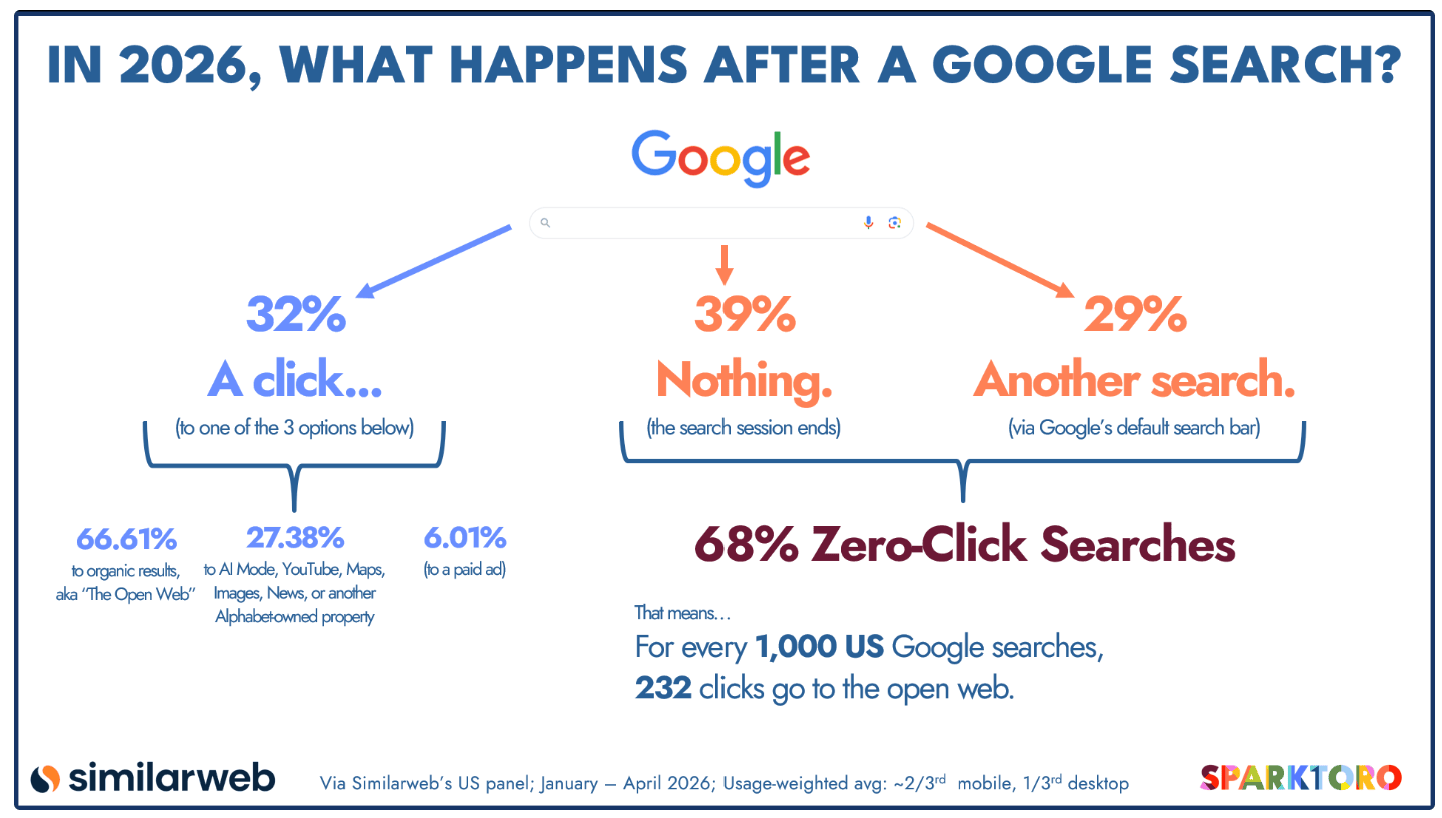
There are 3 possible scenarios:
32% of the time people click to an organic result, to another Google property (Youtube, AI Mode, Maps, Images, etc…)
39% they do nothing after the search.
29% they do another search.
The study found that for every 1000 us Google searches, only 232 convert to clicks to a non-Google property.
That’s not good…
And so far every solution I see proposed to this dilemma misses the biggest opportunity out there…
We forgot that Google has different surfaces
I was listening to a webinar recently about “Google Discover” and it was during this webinar that I got my Aha moment.
Google Discover is a Google surface that shows users content based on their interests. Google also said they’re rolling the feature out on desktop last year—not sure where that went, but they said it’s coming.
Google discover is a huge traffic source, for a lot of website owners, it makes the biggest source of traffic, even more than traditional search. and that’s why we should consider optimizing for discover.
But here’s the thing…
the content that works in Google discover is slightly different than the content that works in traditional SERPs, although there’s an overlap of course.
So what type of content works well in Google Discover?
Content for Google Discover
Your best ideas are going to come from browsing your discover feed and seeing what made it there, however here are some pointers:
Sensational titles. But you need to avoid click bait, lean more on people’s natural curiosity vs been purely click-baity. An example is “New Zealand reaction to Mo Salah’s goal”.
Quoting people in titles. This is something that would not work in traditional SERPs, but for Google discover, having a title like “Mbappe on PSG’s season: “for me, a team that wins will always be an example of football”.
Questions in titles. Some have reported that this type of titles perform really well in discover. Worth testing out. An example is “why men keep dropping out of the workforce: it starts in childhood”
Timely fresh content. Yes you can still get visibility in discover with your evergreen content, but timely content has an edge. One thing you can do is to keep an eye on Google trends for keywords related to your niche, and once there’s something relevant to your audience, you can blog about it.
Images are very important for Google discover. Having the right featured image can improve your CTR there, this is something that is not relevant for traditional search results since you rarely see the featured image in search.
Localized content. Google discover surfaces content that is very relevant to the user and one of the factors that determine relevancy is location. If your customers are in a specific geographical area e.g Ontario, content like “Spring in Ontario. Uncover colors, rhythms and flavors that make this province a true cultural canvas” may work well.
Cheesy: understand your audience
Yes I know saying “understand your audience” is as lame as the Google advice “create helpful content” but it’s a step we rarely do in SEO.
Sometimes when I meet with business owners, I’m pleasantly surprised when they share things like:
“Our target audience are SEO agencies managing multiple clients who need to standardise workflows, speed up repetitive tasks, and maintain consistency without increasing headcount.”
Because then you can tailor interest-based content that would perform well in discover and on socials for your audience.
Topics you may write about for example:
Sensational: What actually breaks first when an SEO agency starts scaling
Quotes: “SEO manager at a 30-client agency: ‘Reporting is where we lose most of our time”
“Why do SEO agencies still do so much work manually in 2026?”
“Inside Canada’s SEO agencies: why reporting is still the biggest time drain”
You are not a ship anchored to the past
Our main focus has always been the 10 blue links, only today there’s rarely 10 blue links anymore… they’re usually less, with a SERPs designed to send less clicks to your website with Google’s AI experiences.
I’m not suggesting you abandon the 10 blue links, I just think you should widen your horizons a bit, and explore other surfaces available to you.
Creating content for Google Discover, can be the answer to your traffic challenges. And you probably have everything already in place:
Google technical foundations for discover highly are practically almost the same as the requirements for traditional serps.
User experience and bounce rate matters a lot for how your content would perform in discover, but these are things we should’ve always taken into account when creating content for SEO, right?
You probably have a social team in place, they can work with SEO to brainstorm content ideas that can work better for both social and discover!
The name of the game for SEO in 2026 is testing every thing, and this is one thing I think you should experiment with.
And That’s a Wrap (Almost 😄)
It’s time we tackle the zero-click reality with a different mindset and play the hand we’ve been dealt. The landscape has changed but there are still real opportunities for those who adapt to how distribution actually works today.
At the same time, we should keep an honest conversation going about the relationship between platforms and publishers.
Google continues to say “create helpful content,” and publishers have done exactly that, investing significant time, money, and effort. Yet the return in the form of clicks and owned audience is becoming harder to measure and less predictable.
As the web shifts toward more zero-click experiences, the question of fairness, attribution, and sustainability for publishers becomes harder to ignore.
We should continue pushing for a web where value flows both ways, not just one where content is consumed but not always returned to its source.
That’s that for today folks and see you in the next newsletter!
Sources Worth Checking
Google Discover Webinar with Barry Adams
Support the Riddler!
Sign up for my newsletter if you’re not already.
Share the newsletter and invite your friends to signup. Help me reach 2k signups by end of 2025 please 🙂
Provide feedback on how I can make this newsletter better!!!
If you’re an SEO tool or an SEO service provider, consider sponsoring my newsletter. I’m also open to other partnership ideas as well.
Disclaimer: LLMs were used to assist in wording and phrasing this blog.